Care Gaps
Identify monitoring gaps
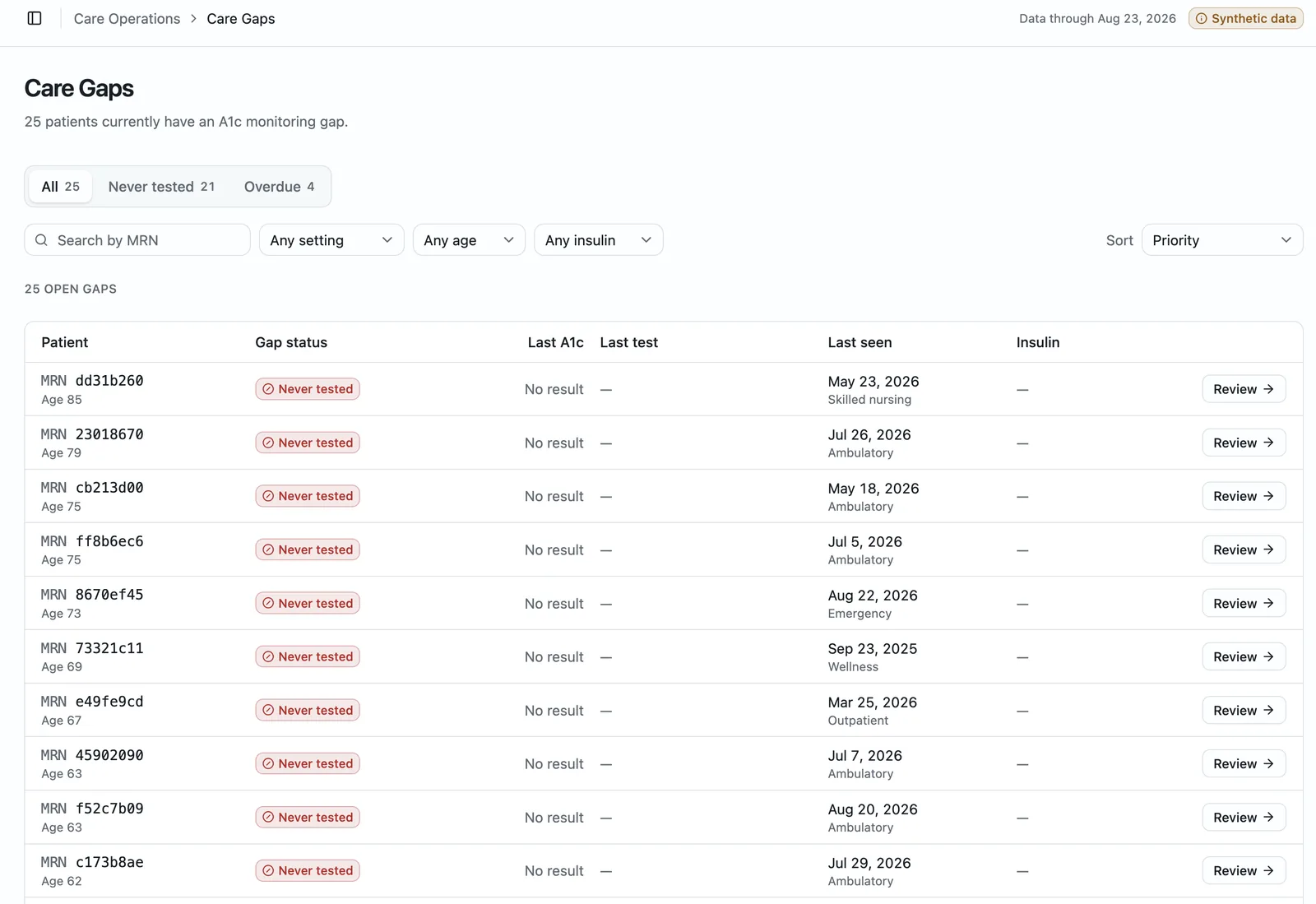
Every patient with an open A1C gap, in one work queue: never tested first, then the longest overdue.
- Filter by status, care setting, age and insulin
- Review any patient's evidence without leaving the list
Why this matters
A1C is a blood test that reflects average blood glucose over roughly the past two to three months. Repeating it is how a care team follows a patient's diabetes from one visit to the next.
When no recent result is on file, that monitoring has lapsed: a care gap. Across a whole population, finding those patients means reading records one at a time, or a measure you can trust and explain.
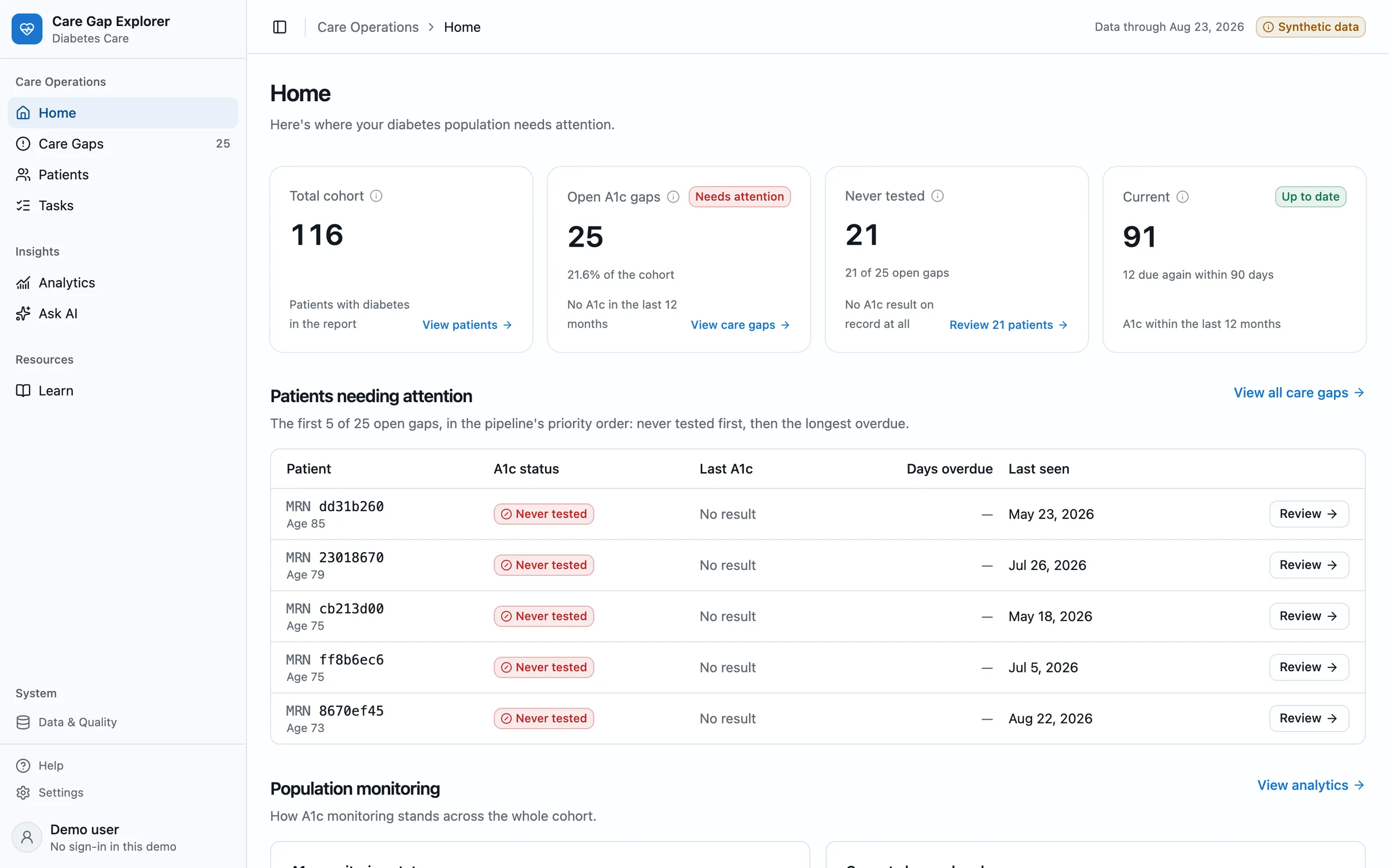
116 patients, measured on Aug 23, 2026. A monitoring status is not a diagnosis and does not determine treatment.
The product
From the population to one patient and back, every page reads the same patient-level measure.
Care Gaps
Every patient with an open A1C gap, in one work queue: never tested first, then the longest overdue.
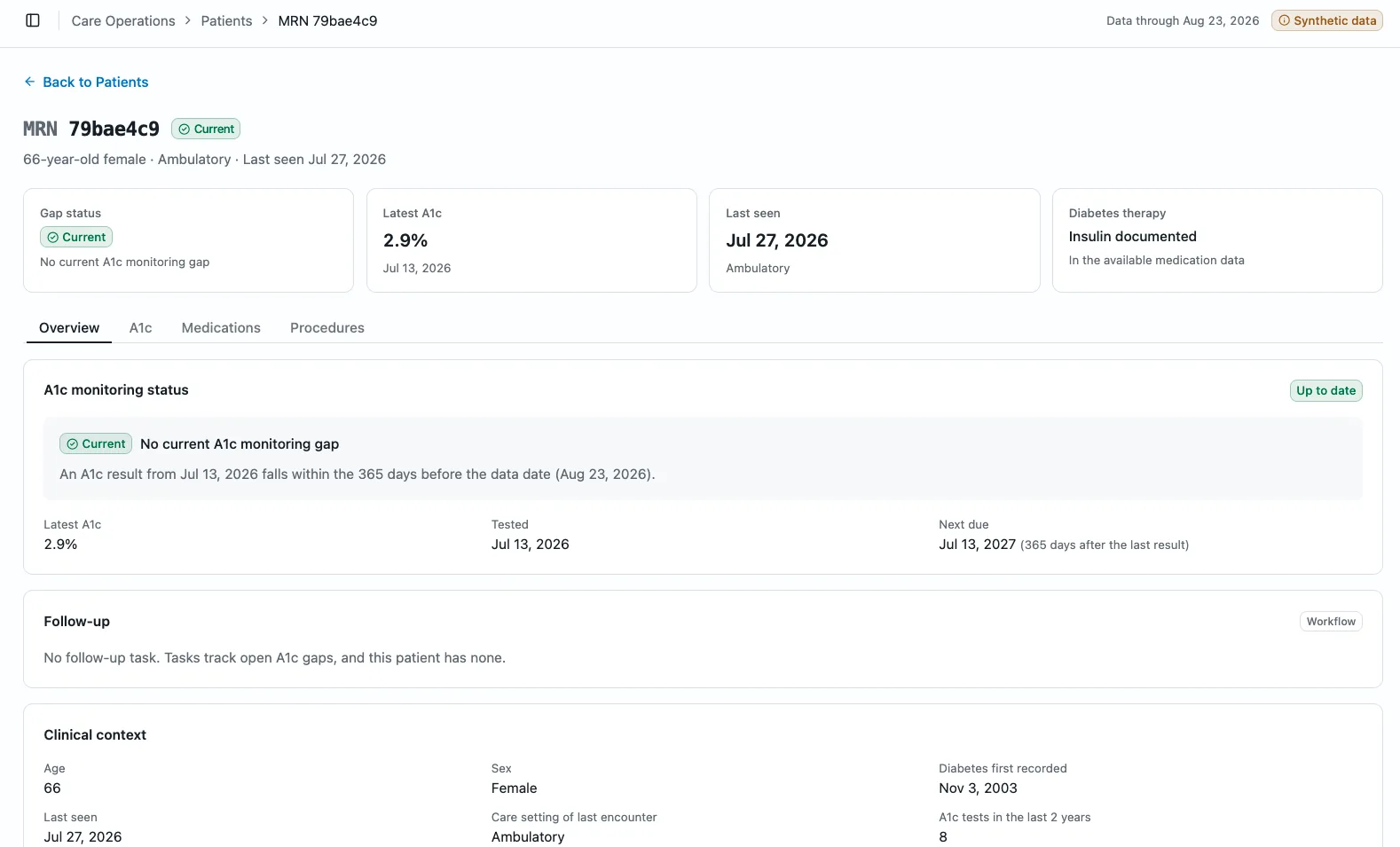
Patient workspace
Why a patient has their status, with the evidence beside it: the latest A1C, every result on file, medications and procedures.
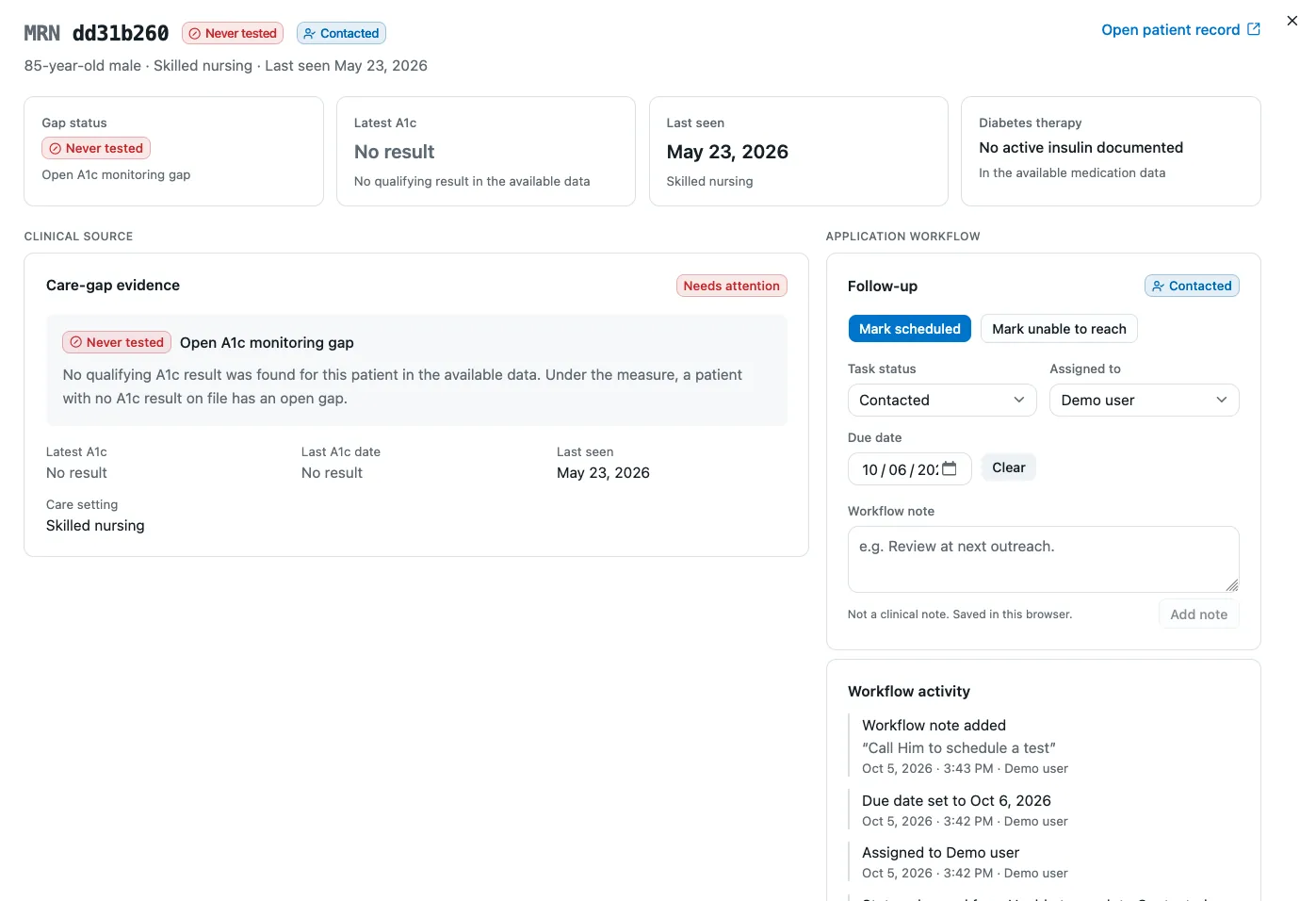
Tasks
A follow-up task for each open gap: status, assignee, due date, notes and every change. Completing a task never changes the clinical status.
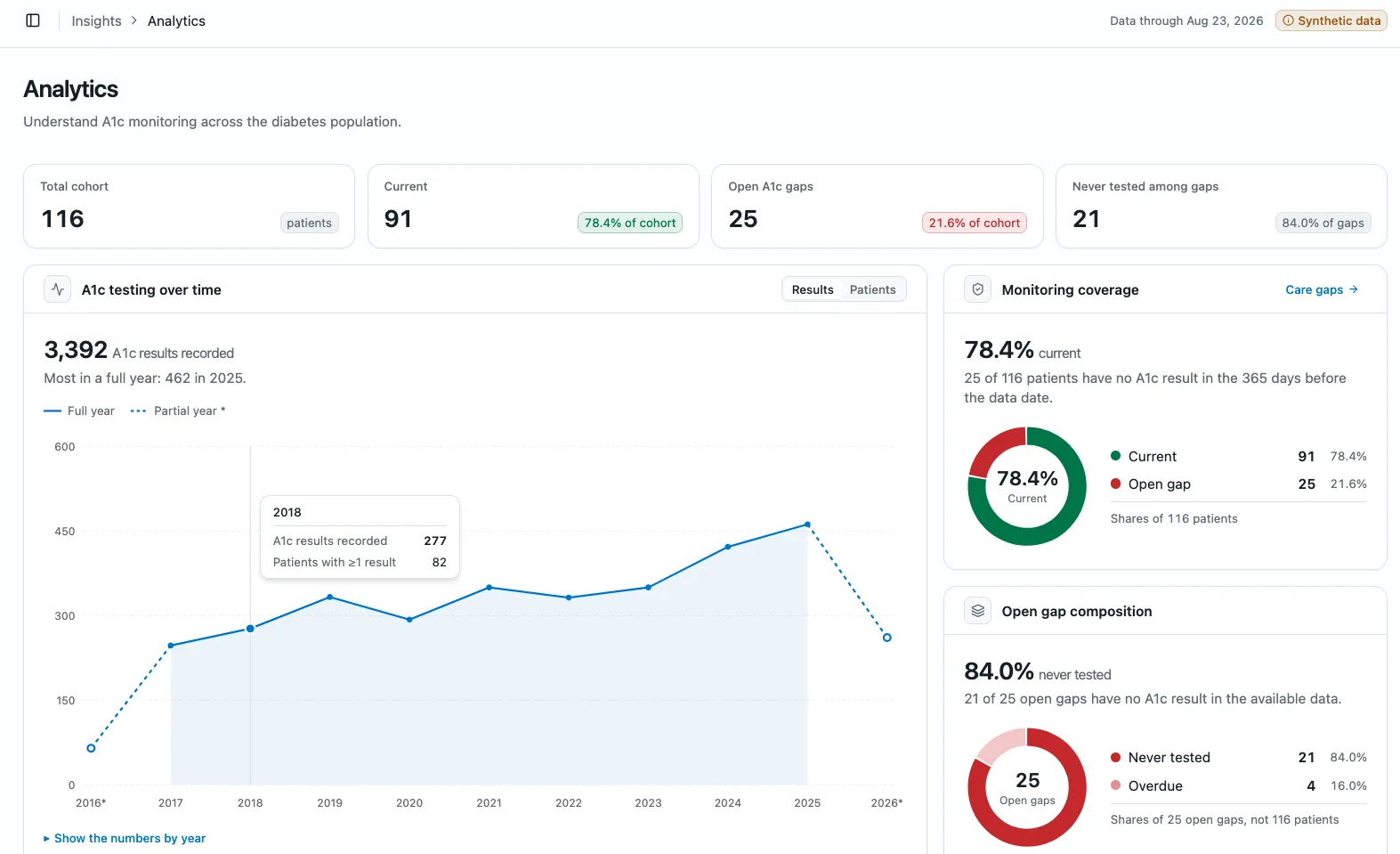
Analytics
How monitoring is going across the whole cohort, always with the denominator in view.
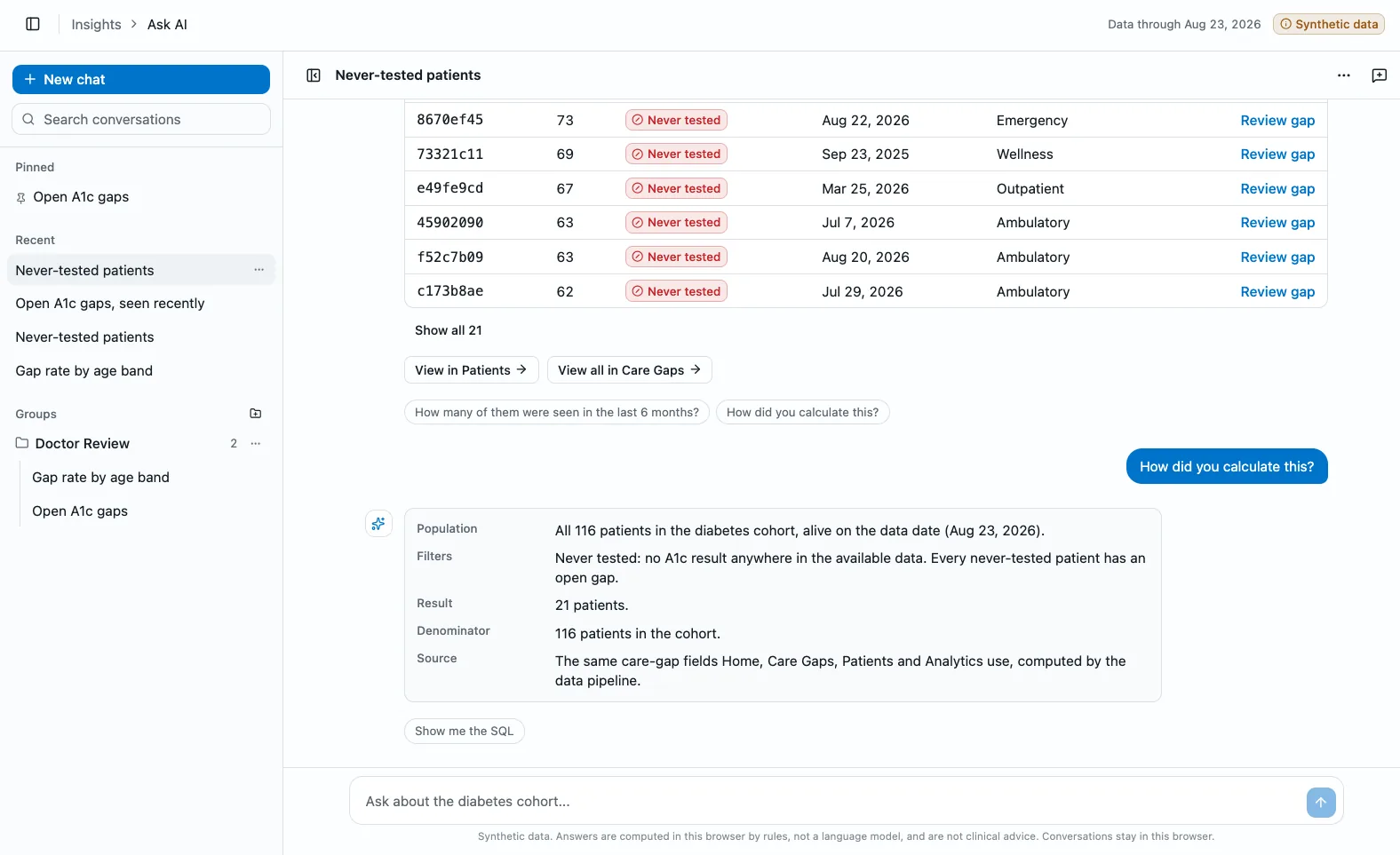
Ask AI
Ask in plain words and get counts, patient lists and comparisons, then ask how the answer was calculated. Rule-based and computed in your browser, not a language model.
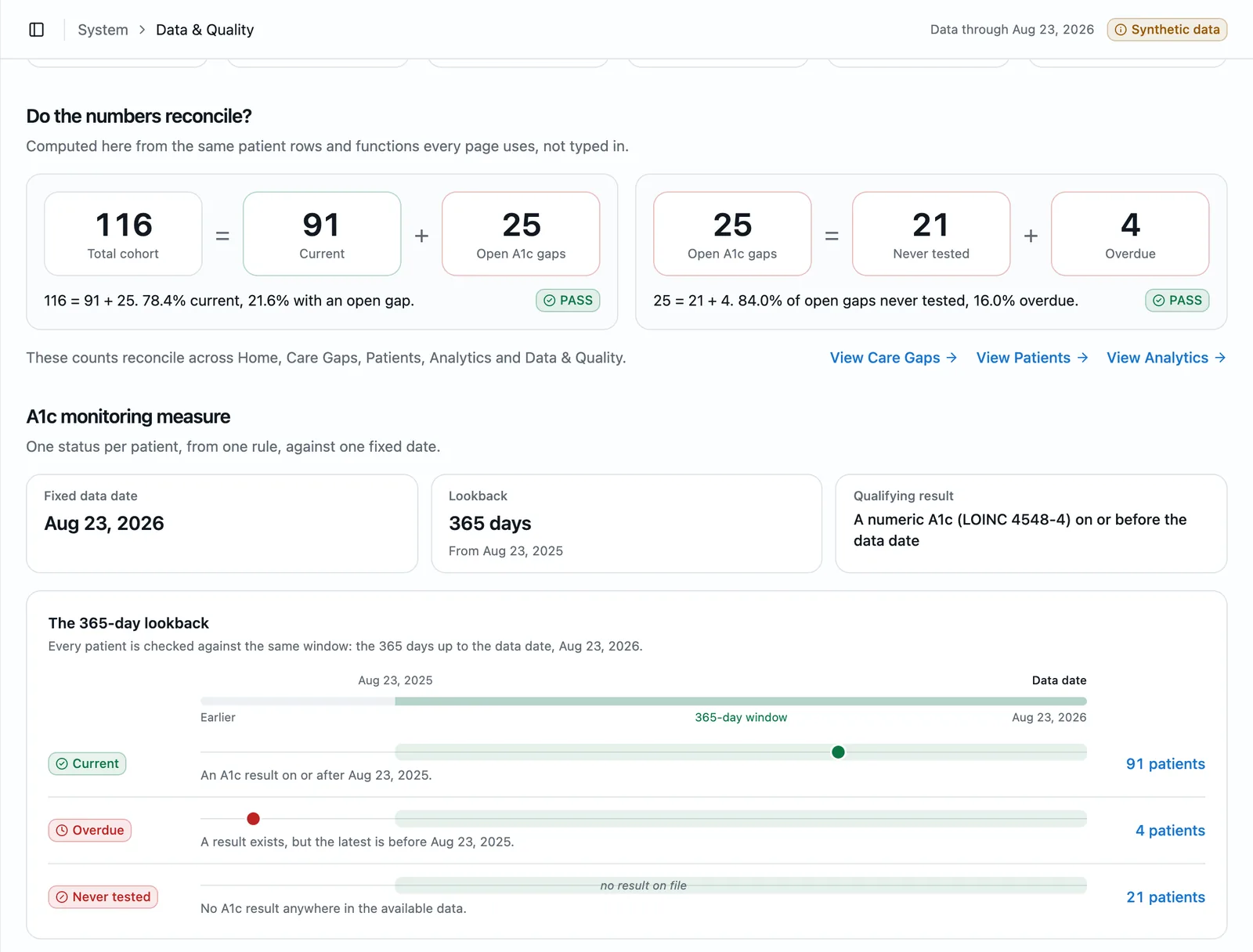
Data & Quality
The pipeline, the checks and the reconciliation behind every figure, computed from the same patient rows every page uses.
How it works
Six steps, each with one job. Each hands the next a smaller, cleaner set, until one row describes one patient.
Health records for 1,159 synthetic patients.
A faithful copy, kept exactly as received.
Checked and typed. 223 problem rows set aside, each with a reason.
116 patients with a recorded diabetes diagnosis, alive on the data date.
One row per patient: the latest A1C and the monitoring status.
The pages you use to find, review and follow up.
Built to be explainable
The decisions that make a care-gap count trustworthy, written down and checked.
One row per patient, so every count is a count of people.
116 patients with diabetes, alive on the data date. Every rate divides by it.
Measured on Aug 23, 2026, the day the data ends, so the answer does not drift.
Current, overdue and never tested, with the 365-day boundary stated: 365 days old is current, 366 is overdue.
Patients without an A1C are kept. An inner join would silently remove all 21.
Problem rows are quarantined with a reason, never quietly deleted.
Every source table balances: source rows = clean rows + quarantined rows.
Checked on every build
116 = 91 + 25
25 = 21 + 4
cohort = current + open gaps; open gaps = never tested + overdue
Learn
Four short modules and three one-minute videos, for healthcare professionals and engineers alike.
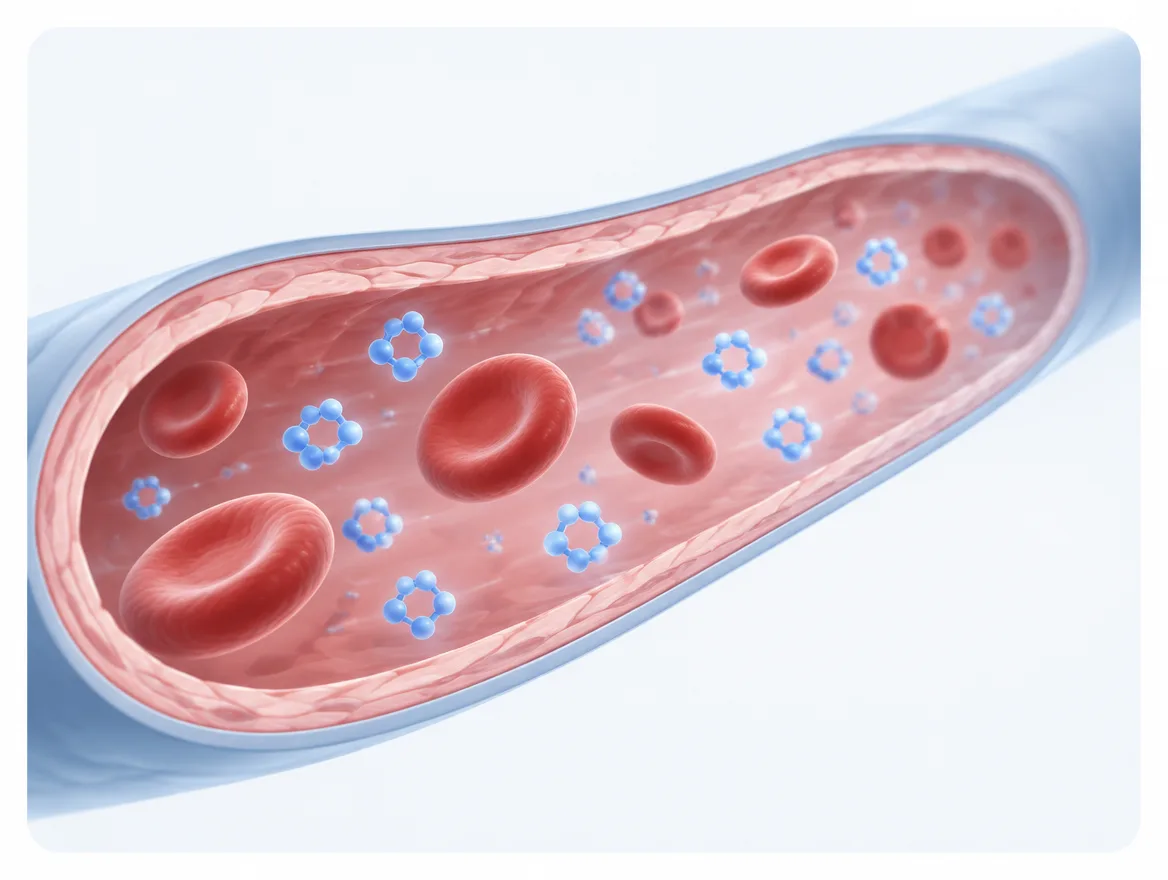
Learn how glucose, insulin and A1C relate to diabetes.
Module + 0:53 video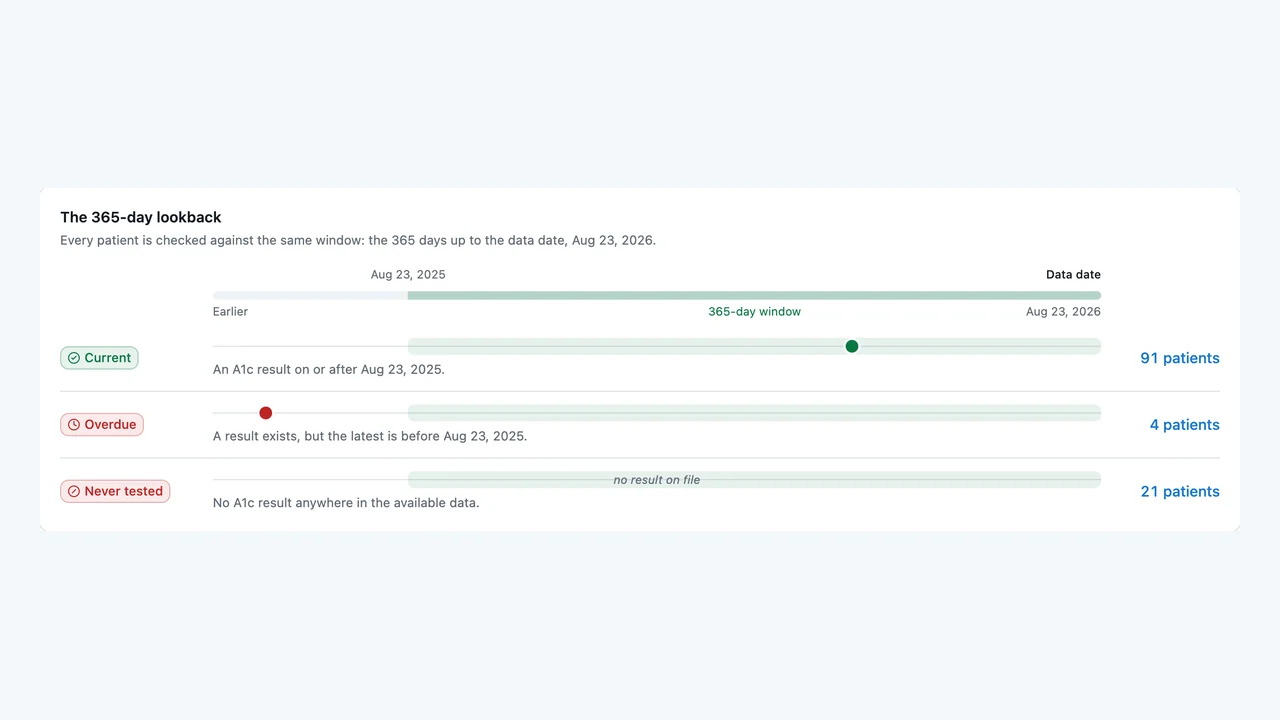
Learn what current, overdue and never-tested statuses mean in this application.
Module + 1:01 videoLearn how to move from population monitoring to patient follow-up.
Module + 1:22 videoLearn how the application's evidence, analytics and workflow can support review.
ModuleTechnical case study
Fourteen slides for data and analytics engineering teams: building the cohort, the join that keeps never-tested patients, patient-level grain, the fixed reporting date, and the checks that reconcile every number.
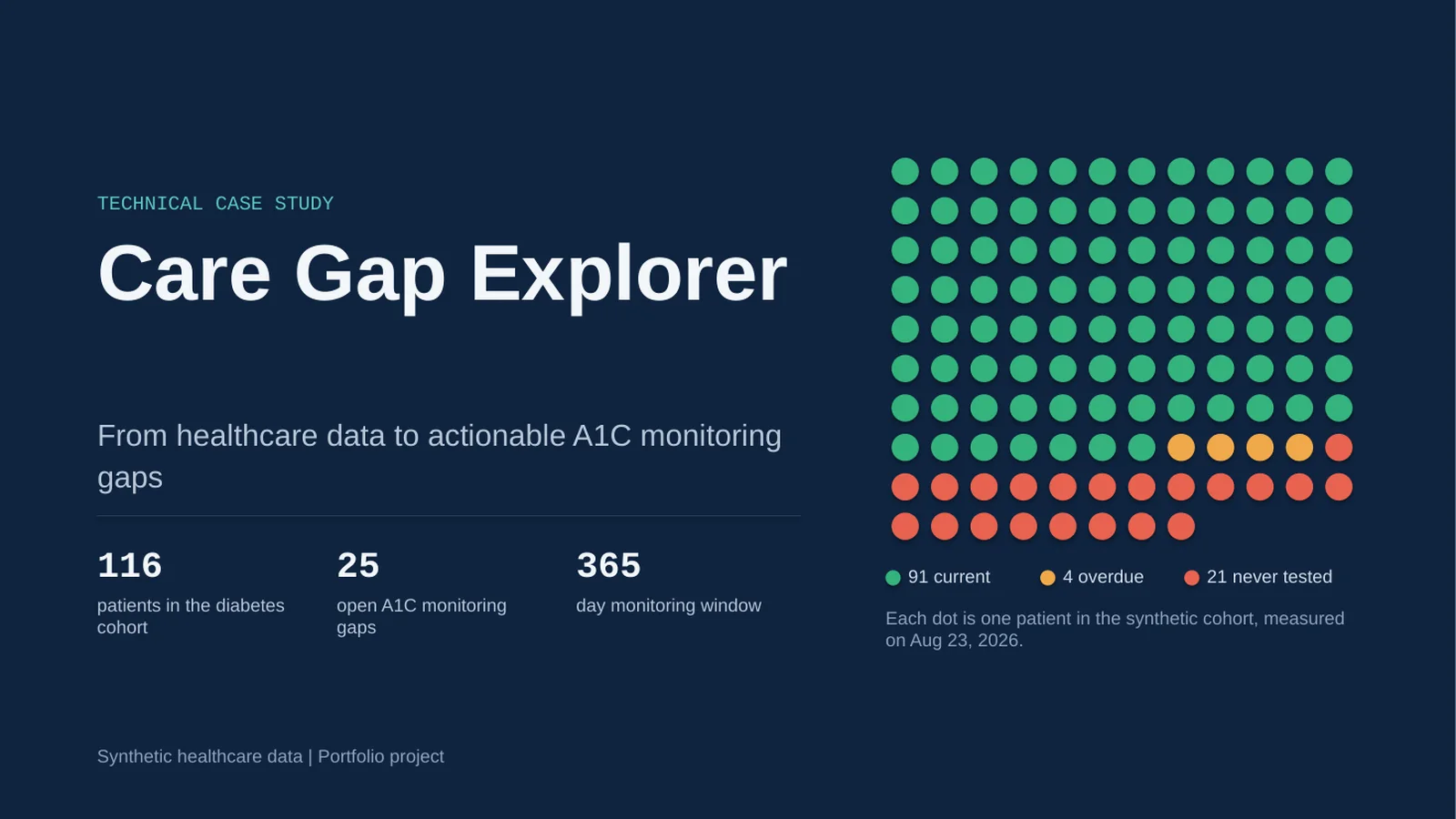
What Care Gap Explorer is, and what it is not.
Built to show healthcare data engineering and product work end to end.
Generated records (Synthea). No real patient appears anywhere; data through Aug 23, 2026.
Not intended for diagnosis or treatment, and makes no recommendation for any person.
Tasks, notes and assignments are demo data, saved only in your browser.
See how healthcare data moves from population-level monitoring gaps to patient-level evidence, workflow and analytics.